

When Dr. Elaine Ingham retired this past October, emotions around the school spanned an array. Our founder and guiding light had finally completed her transition to a well-deserved respite, and it probably goes without saying that it was difficult not to feel some sadness.
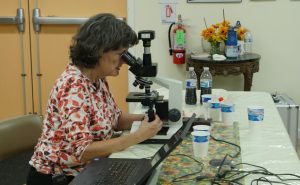
Elaine at a microscopy workshop
But with all that’s been going on this past year, it’s also been easy to feel a certain uplifting contentment, because things are playing out just as they should. Elaine’s retirement came near the conclusion of a big year for her still-young school, at the same time that ecology-minded agriculture keeps gaining interest and converts across the globe. Much of this steady progress was pushed and prodded into being by an ecological researcher who recognized decades ago what needed to be done and spent her professional life working to make it real. And now, at the end of 2025, Dr. Elaine’s namesake school is better positioned than it’s ever been to continue ensuring that her vision plays a distinct role in the future we all share.
Dr. Elaine has played a significant part in the lives of so many of us for quite some time. Many have been lucky enough to meet her at some point, to say nothing of the honor of having been her colleague. After seeing her video lectures (the precursor to the Foundation Courses, likewise delivered in a distance-learning format), and her many appearances online, to meet Elaine was to meet a celebrity, and it was always a delightful comfort to see the warmth with which she greeted her starstruck acquaintances. Alongside her online courses, Elaine spent many years delivering multi-day workshops, where she built compost piles and peered through microscopes with her students for hours on end, offering insights on the nuances of things like feedstock hydration and microbe identification, all of it making students feel so much more confident in their new skills. Elaine would hold larger workshops – around 20 participants, just as we do now – but also smaller events with just a handful, whom she would take out to dinner at the end of the week, “so I can enjoy all of you,” as she would say.
Elaine kept doing these workshops until just a few years ago, when she paused to establish the current version of her school, with all the work that that effort entailed – building a new curriculum, designing new distance-learning and certification components, structuring what we now call the Advanced Programs. Then the global coronavirus pandemic hit, and it took a while – really, right up until this past year – before the new school would finally hit its stride with that same style of in-person learning that Elaine had spent all those years delivering single-handedly, with a seemingly effortless poise.

SFW School Mentor Gerald Ramirez (center) demonstrates production of liquid amendments at our workshop in Costa Rica, March 2025.
Now, Elaine’s workshops are delivered by a team of school mentors, each with their own AP certifications and unique experiences and perspectives. Some bring expertise in smaller-scale farming and composting, some in large-scale production; others contribute training and skills in agronomy, scientific research and microscopy. In 2025 we hosted students in Cyprus, Costa Rica and the United Kingdom, and the first workshop of 2026 is now scheduled (open to all students of the school) in the United States. To bring a bit of that workshop experience to our pre-AP students, in early 2026, our mentors will begin something new: interacting with students of the Foundation Courses through the launch of the FC+ program. The new course will consist of Elaine’s series of pre-recorded lectures, which allow for an individualized pace, but will now help build a stronger community through regular student meetings, where details and nuances of the content will be discussed.
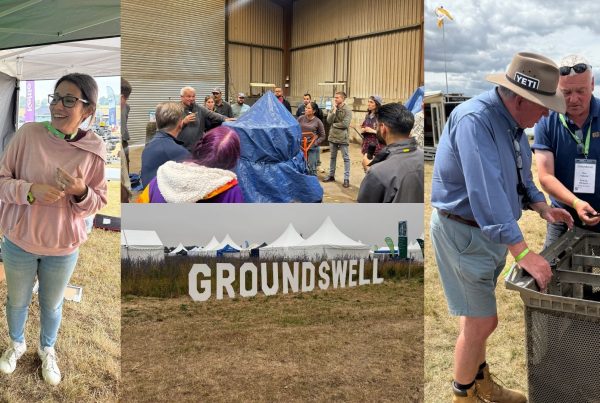
Our June workshop was hosted by Mentor Nick Padwick at the regenerative farm he operates in the UK. Nick spent decades managing farms under conventional regimes, but now produces wheat in an ecologically healthy system for a premium market, with greater profitability. In August, Nick was featured in the UK newspaper The Guardian, which took note of other examples showing that on this path toward ecological health, Nick is in good and growing company. The article featured not just Nick but also SFW School graduate Daniel Tyrkiel, who is working with the country’s largest dairy producer to incorporate regenerative techniques, while also conducting microbiology-focused field trials with University of Manchester researcher Dr. Janice Lake. There’s also G’s Fresh Ltd, a producer that meets most of the UK’s demand for celery and salad greens plus a good portion of the European and US markets; the company is employing principles of fungal development using microbe-rich compost, aiming to implement regenerative practices company-wide by 2030.
That’s the year by which the European Union plans to implement a set of industry guidelines and regulations requiring producers to build and maintain soil health. Adoption of regenerative agriculture principles still accounts for somewhere in the neighborhood of 15% of all the world’s commercial farmland, but the signs of acceleration keep appearing. Governments elsewhere are pointing to policies aimed at furthering the cause, like a recently announced US initiative making it easier to apply for regenerative-practice financial assistance. The current administration may be drawing scrutiny for its overall farm-support policies, but it certainly appeared eager to extol its leadership on an issue steadily gaining popularity. With all this going on, the Soil Food Web School is closing out 2025 by closing in on 100 students having graduated from our Consultant Training Program.
And then there’s the biggest new development for the school: its transition to a nonprofit organization, finalized in October. We’ve met with what seems like universal praise for this move, for which Dr. Elaine and her fellow co-owners donated the school, opening all kinds of possible new avenues for spreading knowledge.
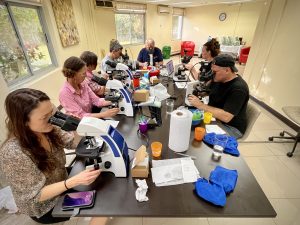
Students and mentors practice microscopy together at our workshop in Costa Rica, March 2025.
In November, the school ran a four-part webinar series that paid tribute to Elaine through the work of some of her most dedicated students. There was Daniel in the UK, with his business partner Adam Swann, discussing the importance of Elaine’s landmark research to their own endeavors; Todd Harrington, who recalled the friendships formed through the early days of Dr. Elaine’s graduate community, starting back in the late-1990s; Celine Basset, whose experience studying with Elaine inspired her own doctoral research on the connections between soil health and national security; Nick Tomasini, who experienced up-close the “buzz” around Elaine’s work at as an undergraduate at Oregon State University, where Elaine and her grad students were conducting research in the early 2000s; Vivian Kaloxilos, an ecologist who felt the field was incomplete before she discovered Dr. Elaine’s work, with its emphasis not so much on problems, but solutions; and Jo Tobias, who sought answers to the problems caused by Green Revolution thinking in the Philippines, her family’s home country. It’s been about a decade since Jo, like her colleagues, found those answers. “Elaine’s work became my compass, and the rest is history,” she said.
What all of Dr. Elaine’s students and collaborators describe is her warmth and encouraging spirit. It was only a short while ago that Elaine was still here at the school every day, providing what could only come from her particular blend of experience, insight and passion. Talking science and field techniques was something Elaine just couldn’t get enough of, passing along daily the insights and details that helped us better understand the science, and better communicate it to others. Sure, the school is buoyed by the world’s growing interest in healthy soils. But the biggest reason for our success this far is the personality of our namesake, infusing all we do with a spirit of respect, curiosity and optimism for a better future.
So, it’s been a good 2025. And 2026 will be even better.
Thank you for everything, Dr. Elaine! And from all of us here at the school, a Happy New Year to all!
Join us on Social Media!
Stay connected with the Soil Food Web School by following us on social media! Connect with us on Facebook, Instagram, YouTube and LinkedIn. If you’re a student with us, you can now add Soil Food Web School to your list of education entries on LinkedIn. Here is a guide on how to do that.